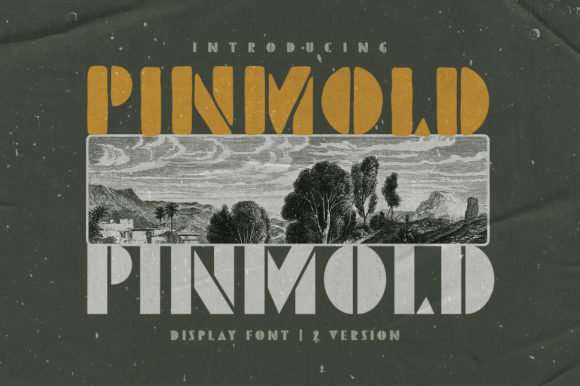
Pinmold: A Bold, Vintage Display Font for Handmade Brands
If you’ve ever spent hours tweaking a label design only to realize the font feels too thin, too generic, or just *off*—you’ll understand why Pinmold landed in my cart and never left. This isn’t just another bold display font. It’s thick, grounded, and intentionally rough—like hand-painted signage from a 1950s roadside diner, but refined enough for today’s boutique shelf or Etsy thumbnail.
Pinmold’s personality shines in its weight and texture. Each letter carries subtle irregularity—the kind that says “crafted,” not “copied.” It’s not distressed for effect; it’s built with character from the baseline up. That makes it incredibly versatile for physical products where authenticity matters: candle jars, soap tags, greeting cards, wedding welcome signs, and even laser-cut wood signs. When customers see Pinmold on your packaging or invitation suite, they don’t just read the words—they feel the care behind them.
Where Pinmold Works Best (and Where It Doesn’t)
Let’s be real: Pinmold is a display font, not a workhorse text face. It thrives at sizes 36pt and up—perfect for headlines, product names, shop banners, and SVG cut files meant for vinyl or iron-on transfers. I use it for:
- Candle & bath product labels — Its boldness holds up beautifully on small kraft paper tags, especially when paired with a clean sans serif for ingredients or scent notes.
- Wedding stationery — Think “Welcome” on a rustic chalkboard sign or “Mr. & Mrs.” on a foil-stamped invitation belly band. It reads clearly from across a room—and photographs like a dream.
- Seasonal printables — Halloween mugs, Christmas market tote bags, Easter egg dye kits—all benefit from Pinmold’s confident, vintage-leaning presence.
- Digital downloads — Planner covers, wall art PDFs, and Canva-ready templates gain instant visual authority with Pinmold as the focal typeface.
It’s not ideal for body text or long paragraphs—no surprise there—but I’ve found it surprisingly legible even at 24pt on printed greeting cards, especially with generous letter spacing. For Cricut and Silhouette users: Pinmold cuts cleanly at medium-to-large sizes. Just avoid intricate inner counters (like the center of “e” or “a”) below 18pt if you’re cutting fine vinyl for tiny stickers.
Pairing Pinmold Thoughtfully
A great display font earns its keep by playing well with others. With Pinmold, contrast is your friend. Its bold, textured energy pairs beautifully with:
- A relaxed script or handwritten font for names, dates, or personal messages—think “Emma & James” in flowing cursive beneath “Est. 2024” in Pinmold.
- A crisp, neutral sans serif (like Montserrat, Poppins, or Inter) for supporting text—ingredients, care instructions, sizing charts, or website URLs on product tags.
- A warm, low-contrast serif (such as Cormorant Garamond or Playfair Display) for elegant balance in wedding or boutique branding—where Pinmold anchors the headline and the serif handles the story.
Avoid pairing it with other heavy, textured fonts—that’s visual noise, not harmony. And while Pinmold stands strong solo on signs or mugs, adding one complementary typeface instantly deepens your brand identity without overcomplicating your design system.
What’s Inside the Pinmold Files (And Why It Matters)
The version I purchased includes OTF and TTF formats—so it installs smoothly on both Mac and Windows, and works reliably in Design Space, Silhouette Studio, Adobe Illustrator, and Canva. There are no ligatures or swashes (and honestly? That’s part of its charm). It’s focused, intentional, and production-ready. No hidden surprises when you go to cut or print.
I checked the character set before buying: full Latin support, standard punctuation, numerals, and basic diacritics—enough for English, Spanish, French, and German product listings. If your shop ships internationally or serves bilingual communities, confirm multilingual coverage matches your needs, but for most handmade sellers in North America and the UK, it’s more than sufficient.
Licensing for Real Sellers
This matters: Pinmold is licensed for commercial use—including physical products you sell, digital templates you list on Etsy, SVG files for crafters, printable wall art, and client projects. You do not need an extended license to put Pinmold on a mug, stitch it onto a tote bag, or include it in a Canva template pack. But always double-check the license terms included with your purchase—some vendors offer different tiers. What I love is that Pinmold’s license covers resale rights without requiring attribution or limiting quantity. That means peace of mind when scaling your shop or launching a seasonal collection.
Why Pinmold Feels Like a Smart Investment
In a sea of trendy fonts, Pinmold avoids chasing trends. Its vintage styling isn’t retro-fussy—it’s timeless, tactile, and quietly confident. That translates directly to perceived value: customers associate its weight and texture with quality craftsmanship. A candle labeled in Pinmold doesn’t look like it came from a big-box store—it looks like it belongs in a curated gift shop or a wedding favor box.
It also supports consistency across touchpoints. Use it for your shop banner, your Instagram story highlights, your product tags, and your holiday promo graphics—and suddenly your brand feels cohesive, even without a full logo system. For small shops still building their visual language, Pinmold acts like a quiet anchor: expressive enough to stand out, sturdy enough to build on.
Most importantly? It saves time. When you find a display font that works this well across stickers, signs, packaging, and digital assets—you stop second-guessing every headline. You trust it. And in the daily rhythm of running a handmade business, that kind of reliability is worth more than pixels.