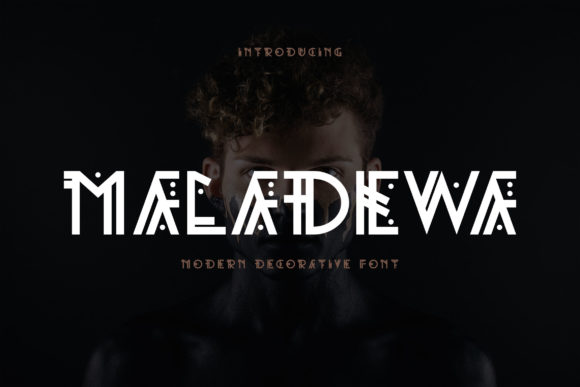
Maladewa Display Font for Handmade Labels & Printables
If you've ever spent hours tweaking letter spacing on a candle label—only to realize the font lacks presence—or struggled to find a typeface that feels luxe but still cuts cleanly on your Cricut, you know how much a single display font can shape how customers see your work. That’s why I reached for Maladewa - Display Decorative the moment I saw its balance of elegance and clarity. It’s not just another script or ornamental typeface—it’s a modern decorative font built for makers who need beauty *and* function.
Maladewa has this quiet confidence: tall x-height, subtle contrast in stroke weight, and refined terminals that give it polish without stiffness. It reads as both timeless and current—think boutique stationery meets contemporary branding. There are no exaggerated swashes or distracting flourishes, which means it holds up beautifully at small sizes (like 8–10 pt on product tags) and shines large (think 60+ pt on welcome signs or wall art prints). It’s designed for display use first—so titles, names, logos, and short phrases land with intention—not for body text, and that’s exactly what makes it so useful in craft production.
I’ve used Maladewa across dozens of physical and digital products: soy candle labels with minimalist ingredient lists, wedding welcome boards printed on birch plywood, printable planner covers with gold foil accents, and even heat-transfer vinyl designs for linen tote bags. Its clean geometry ensures crisp cuts on Silhouette Cameo and Cricut Maker machines—even with intricate inner counters (like the ‘e’ or ‘a’). No pixelation, no jagged edges, no last-minute font swaps mid-project.
For handmade sellers, readability isn’t just about legibility—it’s about trust. A customer scanning your Etsy listing sees Maladewa on your mockup and subconsciously registers “thoughtful,” “professional,” “curated.” That impression carries through to packaging, thank-you cards, and social media graphics. When your brand voice leans into sophistication—say, apothecary goods, slow-fashion apparel, or fine-art prints—Maladewa reinforces that identity without saying a word.
It works especially well where space is tight but impact matters. On 1.5" kraft paper gift tags? Yes. On 2" round sticker seals for soap boxes? Absolutely. Even on curved surfaces like ceramic mugs, its balanced proportions prevent distortion when wrapped or scaled. I tested it on matte vinyl stickers for reusable produce bags—and the letterforms stayed distinct, even after repeated washing.
Seasonal projects benefit too. For holiday collections, Maladewa adds warmth without kitsch—try it on rustic wood ornaments (“Joy,” “Gather,” “Home”) or velvet ribbon tags for luxury gift sets. In spring, pair it with soft watercolor backgrounds for botanical-themed invitations. Summer? Use it bold and unshadowed on beach towel monograms or picnic blanket labels. Its versatility lies in restraint—not flash, but finesse.
Font pairing is where Maladewa truly sings. Because it’s a display font, it pairs best with something neutral underneath: a warm sans serif like Montserrat or Poppins for product descriptions, or a gentle serif like Lora for invitation body copy. Avoid competing scripts—Maladewa doesn’t need backup dancers. Let it headline; let your secondary font support. I often use it for the bride/groom names on wedding suites, then switch to a light-weight sans for date, venue, and RSVP details. The contrast creates hierarchy—and guides the eye naturally.
Before downloading, check what’s included. Maladewa comes in OTF and TTF formats (fully compatible with Cricut Design Space, Silhouette Studio, Canva, and Adobe apps), supports Latin-based languages, and includes standard ligatures for smoother connections in words like “with” or “flow.” While it doesn’t include stylistic alternates or swashes, that’s intentional—its strength is consistency, not variation. That uniformity makes batch production easier: same font, same look, across 50 candle labels or 200 printable place cards.
One practical note many makers overlook: licensing. Maladewa is a commercial font, meaning you’re fully covered to use it in physical products you sell (stickers, shirts, mugs), digital downloads (PDF planners, SVG cut files, Canva templates), and client work (logo design, packaging, social assets). Just avoid reselling the font file itself—that’s never allowed. But printing it? Cutting it? Embedding it in your PDFs? All clear. That peace of mind lets you focus on making—not worrying about permissions.
Real-world examples that worked for me:
- Candle labels: “Lavender & Sage” in Maladewa over cream kraft paper—clean, calming, shelf-ready.
- Wedding signage: “Mr. & Mrs.” carved into reclaimed wood using Maladewa’s bold weight—no sanding needed for crisp lines.
- Digital printables: “2025 Monthly Planner Cover” in Maladewa + light gray sans body text—downloads consistently rank higher in Etsy search.
- Tote bag transfers: “Made With Love” centered on organic cotton—holds detail even after heat pressing.
- Holiday packaging: “Hand-Poured • Small Batch” stamped on rigid mailer boxes—adds perceived value before the box is even opened.
What sets Maladewa apart from other decorative fonts isn’t just how it looks—it’s how it *performs*. It doesn’t sacrifice cutability for style, nor readability for flair. It’s the kind of typeface that disappears into your design while elevating everything around it. If your goal is to make handmade feel intentional, premium, and quietly memorable—this is the display font that delivers, project after project.